A hotel company just reminded me why this sector is so hard, and so worth it
I worked in Seniors Living for over ten years before I came to Pluss, and I have spent the years since sitting alongside operators across retirement living, aged care and land lease communities. So when a global hotel group stood up at the recent National Retirement Living Summit in Brisbane and started talking about belonging, I took notice.
Adrian Williams, Accor's Chief Operating Officer for the Pacific, runs close to 400 hotels across this region. He could have talked about occupancy, rates or distribution. He didn't. His whole message was about emotional connection, belonging, and human led experience. His closing slide put it plainly. The future is experience and human led connections. Employees need a culture that connects. Emotional connection drives engagement. Everything can be an experience, not just a transaction.
I agree with almost all of it. But I left the room thinking our version of this is harder than his, and deeper too.
What the hotel gets right, and what we carry that they don't
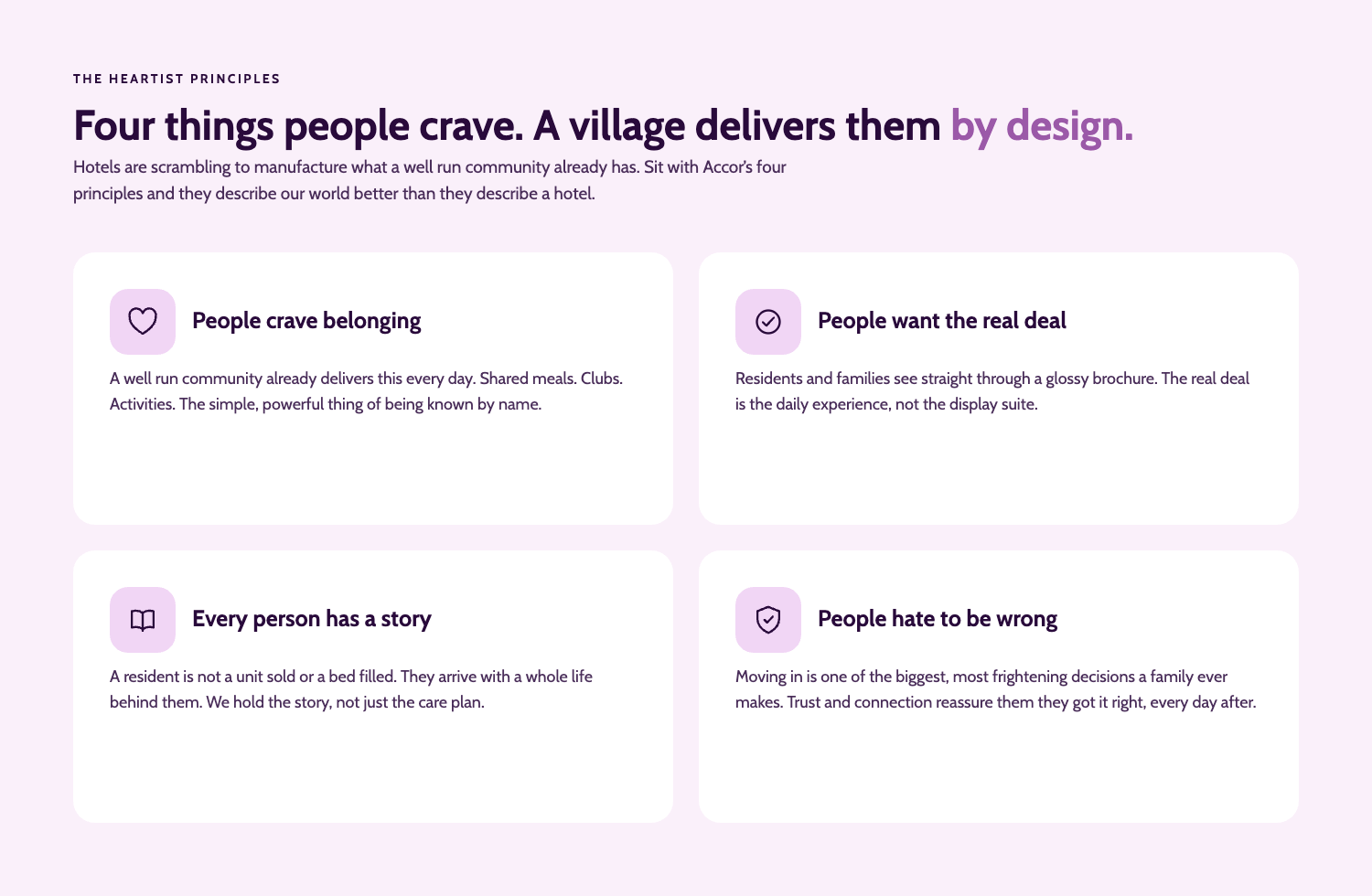
Williams built his argument on four principles Accor calls its Heartist approach. People crave belonging. People want the real deal. Every person has a story. People hate to be wrong. Sit with those for a moment in the context of a seniors living community, because they describe our world far better than they describe a hotel.
People crave belonging. A well run community already delivers this every day. Shared meals. Clubs. Activities. The simple, powerful thing of being known by name. Hotels are scrambling to manufacture what we have by design.
People want the real deal. Residents and their families see straight through a glossy brochure. They want honest, lived community, not a marketing version of it. The real deal is the daily experience, not the display suite.
Every person has a story. This is the one that stayed with me. A resident arriving at one of our communities is not a unit sold or a bed filled. They arrive with a whole life behind them. Decades of it. Hospitality treats a guest's story as a competitive edge. We are holding the stories of people's entire lives, and too often we capture a care plan instead of a person.
People hate to be wrong. Moving into a retirement village, an aged care home or a land lease community is one of the biggest and most frightening decisions a person and their family ever make. Trust and connection are what reassure them they got it right. Not just on the day they sign, but every single day after.
Belonging is an inside job, and it asks everything of our people
Here is where our world and the hotel world part ways.
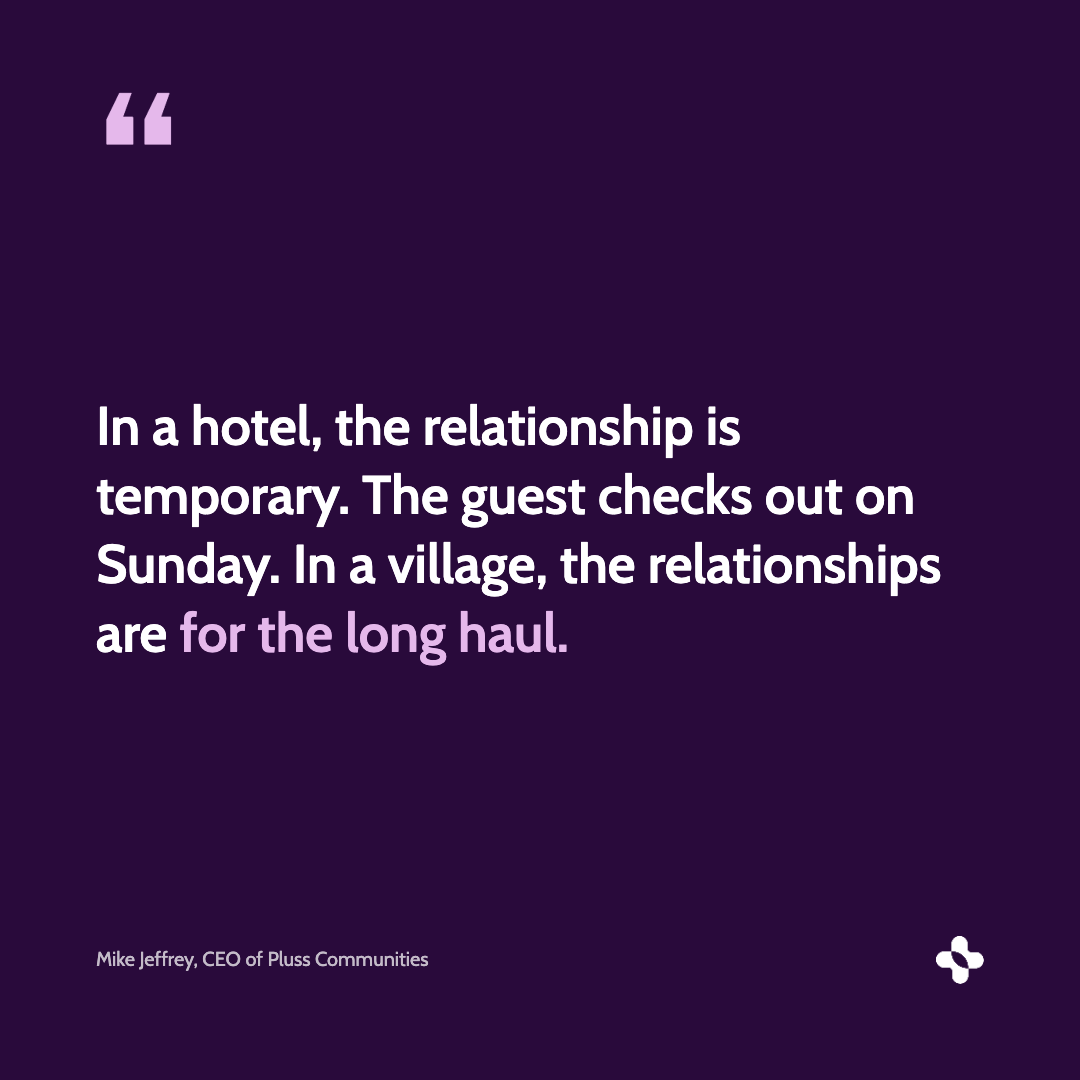
In a hotel, the relationship is temporary. The guest checks out on Sunday. In a village, the relationships are for the long haul. They require stamina and fortitude. There are factions and infighting amongst residents. There are maintenance issues that take far too long to fix. There are systems that frustrate everyone. There is a menu that just cannot seem to land, no matter what the kitchen tries.
And through all of it, the village manager has to find a way. They have to work through the issues and stay positive. They have to keep showing up, keep engaged. They have to find the compassion and the empathy to get residents laughing and living together again, to make peace, to resolve conflict, to help people feel they belong. And then, on top of all that, to lead. To dream about a better village and actually build it, to make the place great for everyone.
I don't know how the best of them do it. I really don't. Accor brands its people Heartists, a blend of heart and artist, because the frontline is where belonging is built or quietly lost, one interaction at a time. They are right. But our frontline is not greeting a guest for two nights. They are holding a whole community together for years. That is a far harder, far more human job, and it deserves a lot more respect than the sector usually gives it.
I live a version of this too
I want to be honest about something, because it is the part of all this I feel most.
Relationships in this sector, as a software provider, do not always go to plan. Sometimes I am the one on the phone, or in the room, apologising. Because the support wasn't what a customer expected. Because a product update came later than they needed it. Because we could have been clearer about what we would and wouldn't deliver. Those conversations are not comfortable. But they are the job.
Our relationships, like a village manager's, are for the long haul. Reputation, trust and longevity matter, because leaders in this sector move around. The person you let down at one organisation turns up running another two years later. So you work hard to do the best you can, even when things don't turn out the way you planned. You stay in the relationship. You front up. You fix what you can and you are honest about what you can't.
That is the real lesson I took from a hotel executive talking about belonging. The principle is the same whether you are a village manager, an aged care worker, or a CEO of a software company. Human led relationships are hard, they are long, and they are everything.
And yes, it pays
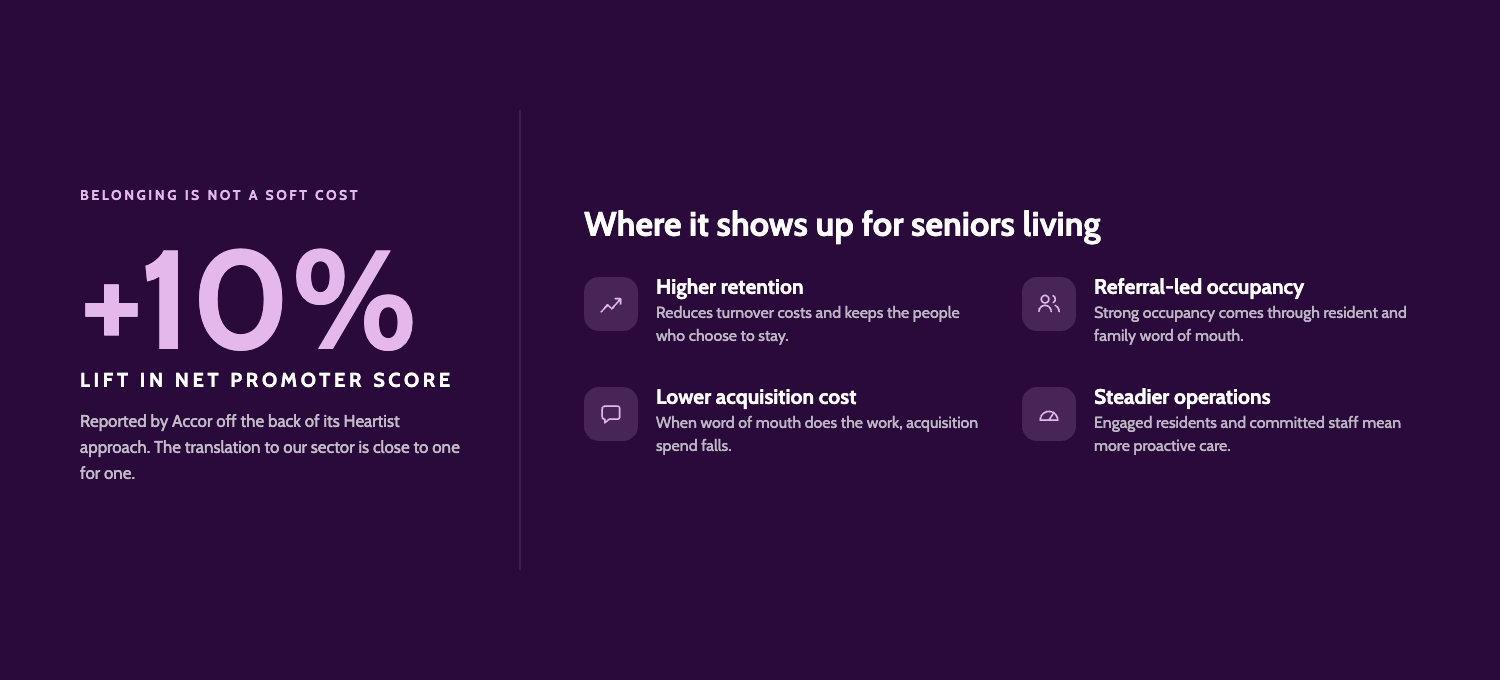
The natural objection in a room of operators is that all of this is soft and unmeasurable. Williams pre-empted it. He put the Heartist approach straight against the numbers a board actually watches, and Accor reported a 10 percent lift in net promoter score off the back of it.
The translation to our sector is close to one for one, whichever part of it you work in. Higher retention reduces turnover costs. Strong occupancy comes through resident and family referrals. Acquisition cost falls because word of mouth does the work. Engaged residents make for more proactive care and maintenance. Committed staff make for steadier operations. Belonging is not a soft cost. It shows up in occupancy, in referrals, in lower acquisition spend, and in the people who choose to stay.
The question I am leaving with
If Williams is right, and I think he is, then the question for all of us is simple. What are we actually doing, every single day, to make people feel they belong, and to make this an experience rather than a transaction.
That connection is never delivered by a brand campaign. It lives in the daily texture of community life. The events. The communication. The small rituals. The feeling of being known. That is the layer technology should be making easier for our frontline people, not harder. It is the part of this business I care about most, and the part I most want us to get right.
I would love to hear how others in the sector are thinking about it.
Mike Jeffrey is CEO of Pluss Communities. Pluss was a proud sponsor and exhibitor at the 2026 National Retirement Living Summit.